July 10, 2024 · Fertilization & Weed Control
Every lawn in Hamilton County deals with weeds. The question isn't whether you'll have them. It's which ones you're dealing with and whether your approach is actually working. Here are the five weeds we see most often on Noblesville, Carmel, Westfield, and Fishers properties, how to identify each one, and what it takes to get rid of them.
1. Crabgrass
The most hated weed in Indiana. Crabgrass is a light green, low-growing annual grass that spreads outward in a star pattern from a central root. It thrives in hot, sunny spots, especially along driveways, sidewalks, and curb lines where heat radiates off the pavement. Each plant produces up to 150,000 seeds before it dies in the fall.
How to stop it. Prevention is everything. Pre-emergent herbicide applied in early April, before soil temperatures reach 55 degrees, creates a chemical barrier that stops crabgrass seeds from germinating. Once crabgrass is actively growing, post-emergent herbicides can knock it back, but they're less effective than preventing it in the first place. A thick, tall lawn (mowed at 3.75 to 4 inches) shades the soil and makes it harder for crabgrass to get started.

2. Dandelions
Bright yellow flowers that turn into white puffballs loaded with seeds. Dandelions are perennials with deep taproots that can reach 18 inches in clay soil. Pulling them out by hand rarely works because the root snaps off underground and regrows within days.
How to stop them. Post-emergent broadleaf herbicide, applied in fall when the plant is pulling nutrients down to the root for winter storage, is the most effective treatment. Pre-emergent won't stop dandelions because they're perennials that regrow from the root, not from seed. A thick, healthy lawn is the best long-term defense. Read our full guide on dandelion control.
3. White Clover
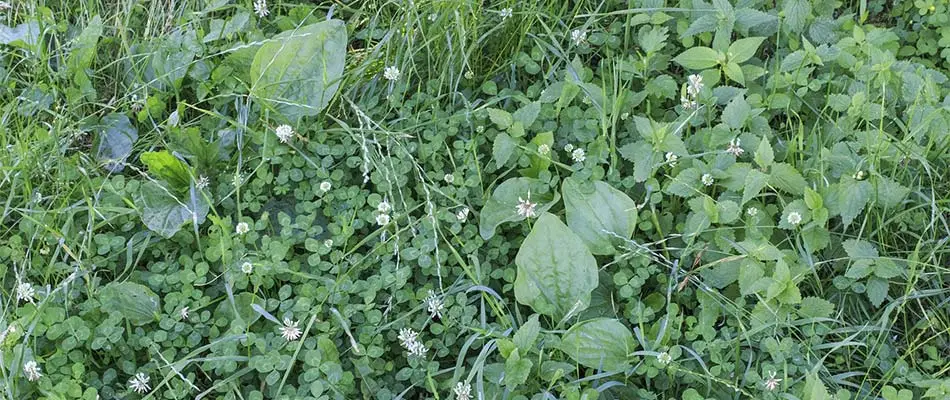
Low-growing with small round white flower heads and three-part leaves. Clover thrives in lawns that are low in nitrogen because it can fix its own nitrogen from the air. If your lawn has a lot of clover, it's telling you the soil is nitrogen-deficient.
How to stop it. A consistent fertilization program that keeps nitrogen levels up will make the grass outcompete clover over time. Post-emergent broadleaf herbicide will kill existing clover. But if you keep seeing it come back, the underlying issue is soil fertility, not the clover itself.

4. Yellow Nutsedge
Often mistaken for a grass, nutsedge stands taller than the surrounding turf and has a distinctive bright yellow-green color with a triangular stem (roll it between your fingers and you'll feel the three sides). Nutsedge loves wet, poorly drained areas and spreads via underground tubers called "nutlets."
How to stop it. Standard broadleaf herbicides don't work on nutsedge because it's not a broadleaf. It's a sedge, which requires a specialized herbicide. Improving drainage in problem areas also helps because nutsedge thrives in soggy conditions. Aeration can improve drainage in compacted clay soils where nutsedge tends to take hold.

5. Canada Thistle
Spiny, aggressive, and hard to kill. Canada thistle has deep roots and spreads both by seed and by underground rhizomes. You'll recognize it by the prickly leaves and purple flower heads. It often shows up along fence lines, in neglected corners, and in thin areas of the lawn.
How to stop it. Repeated post-emergent herbicide applications over the course of a season. Thistle's deep root system makes it resistant to a single treatment. Multiple applications weaken the plant over time until the root system gives out. Mowing thistle before it flowers prevents seed spread, but mowing alone won't kill it. You need chemical treatment to get the roots.

The Common Thread
Every weed on this list exploits the same weakness: thin, stressed turf with bare soil exposed. The healthier and thicker your lawn is, the fewer weeds you'll deal with. That means proper mowing height, consistent fertilization and weed control, and fall aeration and overseeding to fill in thin spots every year.
If weeds are winning on your property, we can help. We serve Noblesville, Carmel, Westfield, Fishers, and the rest of Hamilton County. Call (317) 900-7151 or get instant pricing online.